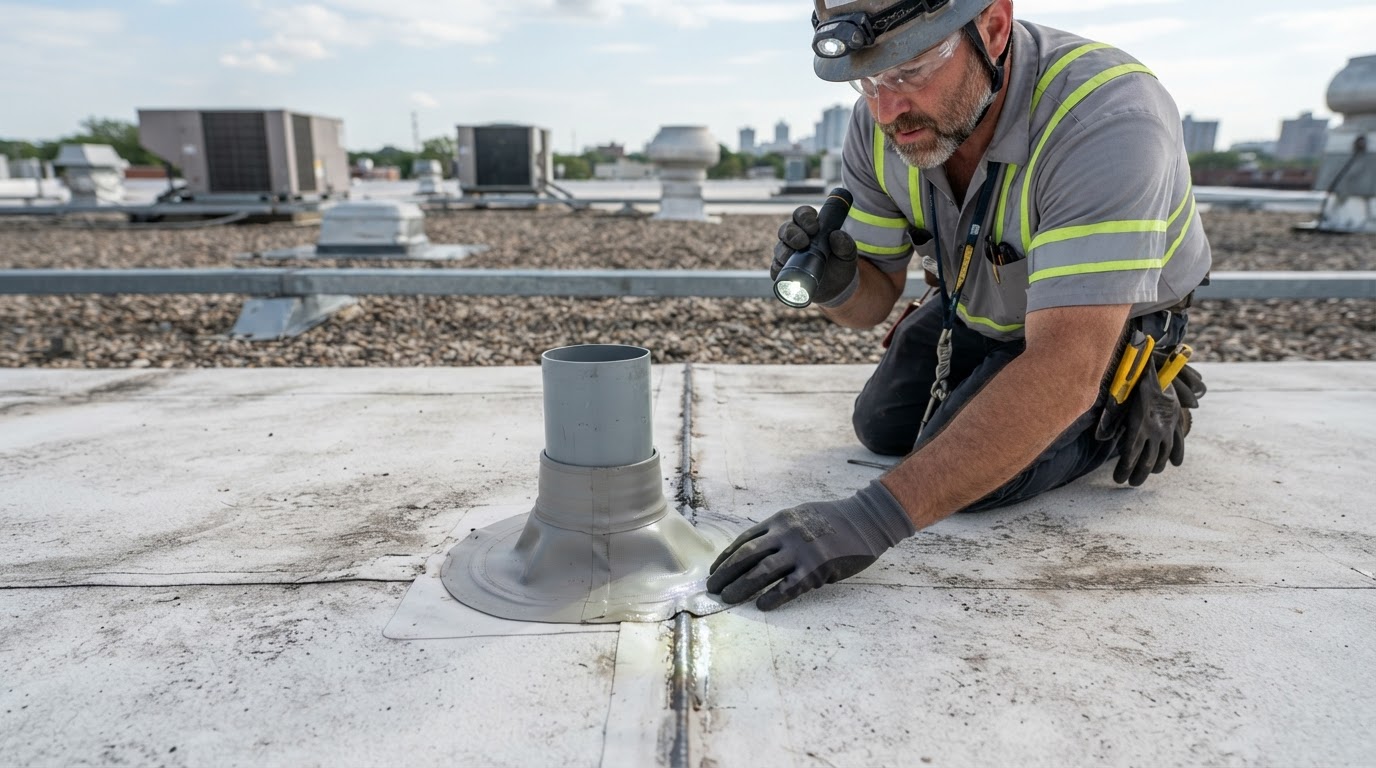
Commercial Roof Repair
Commercial Roof Repair in Syracuse, NY
Common Problems
What Goes Wrong on Commercial Roofs
Commercial low-slope roofs fail in predictable ways. Seams part, flashings pull away from curbs and walls, penetrations lose their seals, and drainage falls behind. In Central New York, freeze/thaw cycles and snow load accelerate all of it. The list below covers the problems we see most often on Syracuse commercial buildings.
Active leaks
Water entering the building through a membrane breach, failed seam, or open flashing.
Membrane damage
Punctures, tears, blisters, splits, and ridging in EPDM, TPO, PVC, or modified bitumen.
Failed seams
Seams that have parted, lifted, or lost adhesion — a common entry point for water.
Flashing failures
Base flashing, curb flashing, and edge metal pulled away, cracked, or unsealed.
Penetration issues
Pipe boots, vent stacks, and HVAC curbs where seals have failed or shrunk.
Ponding water
Standing water that won't drain, degrading the membrane and inviting vegetation.
Storm & wind damage
Wind-lifted membrane, hail punctures, and debris damage from Central New York storms.
Drainage problems
Clogged or undersized drains, scuppers, and overflow that back water up onto the roof.
Leak Investigation
Finding the Real Source of a Leak
A ceiling stain tells you where the water came out — not where it got in. Water travels along roof decks, insulation, and structural members before it appears inside, so the entry point on the roof is often far from the visible damage below.
We trace the water path from the interior sign back to the actual breach. That means inspecting seams, flashings, penetrations, drains, and the membrane itself — not just patching the spot above the stain. Fixing the cause is what stops the leak from coming back.
Roof Systems
Roof Systems We Repair
We repair the full range of low-slope and metal systems used on commercial and industrial buildings in Central New York. Each system has its own failure modes and compatible repair materials.
EPDM rubber
Black rubber membrane repairs — patches, seam bonding, flashing, and penetration seals.
TPO
White thermoplastic membrane repairs — heat-welded seams, patches, and corner detailing.
PVC
PVC membrane repairs including seams, patches, and flashing around penetrations and curbs.
Modified bitumen
Torch or cold-applied modified bitumen repairs — blisters, splits, and flashing.
Built-up roofing (BUR)
Gravel-surfaced and smooth BUR repairs including blisters, splits, and flashing.
Metal roofing
Loose fasteners, seam and panel repairs, flashing, and rust treatment on metal roofs.
Flat Roofs
Flat Roof Repairs
Most commercial buildings in Syracuse have some form of low-slope or flat roof. Flat roofs concentrate water, so drainage and seam integrity matter more than on pitched roofs. We repair blisters, splits, punctures, open seams, failed flashing, and saturated areas — and we address the drainage conditions that caused them where we can.
Single-Ply
EPDM, TPO & PVC Membrane Repairs
Single-ply membranes — EPDM, TPO, and PVC — are repaired differently. EPDM uses adhesive-bonded patches and seam tape. TPO and PVC are heat-welded at seams and patches. Using the wrong method on the wrong membrane leads to repairs that don't hold. We match the repair to the system.
Common single-ply repairs include patching punctures and tears, re-bonding parted seams, replacing failed pipe boots, repairing curb flashing, and addressing shrinkage that has pulled flashing away from edges.
Metal
Metal Roof Repairs
Commercial metal roofs fail at fasteners, seams, and flashings — and through corrosion. We tighten or replace backed-out fasteners, seal moving seams, repair flashing at penetrations and transitions, and treat rust before it spreads. For deeper detail on metal systems, see our commercial metal roofing page.
Detailing
Flashings, Seams & Penetrations
The majority of commercial roof leaks trace to detail areas — where the membrane meets a wall, curb, penetration, or edge. These transitions move with temperature, take the brunt of weather, and are where most assemblies fail first. We give flashings, seams, and penetrations focused attention rather than treating them as an afterthought.
Drainage
Drainage & Ponding Water
Water that doesn't leave a flat roof becomes a problem. Ponding water degrades membranes, adds weight, freezes in winter, and invites vegetation. We clear clogged drains and scuppers, address sagging areas, and — on larger projects — improve slope so water moves off the roof instead of sitting on it.
Storm Damage
Storm & Weather Damage
Central New York storms bring wind, hail, and heavy precipitation. Wind can lift membrane at edges and tear flashings. Hail can puncture or bruise membranes and dent metal panels. After a storm, an inspection catches damage before it becomes a leak. We handle storm repairs and can document conditions for your records.
Decision
Repair vs. Replacement
A repair makes sense when the roof still has service life and the problem is contained. When the membrane is failing broadly, insulation is saturated, or the deck is compromised, repairs become a running cost without solving the underlying condition.
We won't push replacement if a repair will hold — and we won't bury the fact when a roof has reached the end of its service life. If restoration is an option, our roof coatings page covers when a coating system can extend a sound roof without a full tear-off.
Process
Our Commercial Roof Repair Process
Investigate the leak
We trace the water path from interior stain back to the actual entry point on the roof, which is rarely directly above the visible damage.
Assess the repair
We evaluate whether a targeted repair will hold or whether the surrounding area needs attention to prevent recurrence.
Perform the repair
Using materials compatible with the existing system, we complete the repair to manufacturer-compatible methods.
Check drainage
Where drainage contributed to the failure, we clear or correct it so the same condition doesn't return.
Document findings
You receive a record of what we found, what we did, and what to watch going forward.
Recommend next steps
If the repair points to a broader condition, we tell you and suggest the right long-term fix — including maintenance or restoration.
Buildings
Buildings We Service
We repair roofs on warehouses, office buildings, retail plazas, restaurants, medical facilities, manufacturing plants, schools, churches, and multifamily buildings across Syracuse and Central New York. Different buildings put different demands on a roof, and we tailor the repair and scheduling to the building's use.
Local Conditions
Syracuse & Central New York Weather
Freeze/thaw cycles widen seams and flashings overnight. Lake-effect snow adds weight and clogs drains. Ponding water that freezes expands and forces membrane apart. We factor Central New York conditions into every repair so the fix holds through a Syracuse winter, not just a dry season.
FAQ
Commercial Roofing Questions
How do you find the source of a commercial roof leak?
Can you repair just the damaged area, or does the whole roof need work?
Do you handle emergency commercial roof leaks?
What roofing systems do you repair?
How long does a commercial roof repair take?
Can repair work prevent future leaks?
Request a Commercial Roof Assessment
Tell us about your building and the roofing concern. We'll inspect the roof, identify the problem, and give you a clear scope and estimate — whether that's a targeted repair, restoration, or full replacement.
For Building Owners & Managers
Property managers, facility managers, and business owners rely on us for clear communication, documented findings, and practical repair-vs-replacement recommendations — not automatic replacement.